
Its performance is not luck. It is the result of a highly disciplined management system built over decades, one that treats organisational tensions as sources of energy.

Five key takeaways from Würth’s operating model
Instead of choosing between two extremes or compromising in the middle, Würth deliberately does both. This ability to hold contradictions productively drives clarity, speed and profitable growth. These five takeaways explain why.
1. Mastery of dilemma thinking: doing both
As described in 21st Leaders for the 21st Century by Fons Trompenaars and Charles Hampden-Turner, highly successful business leaders apply a both-and leadership style, reconciling dilemmas rather than choosing sides. Leadership is neither authoritarian nor participative, nor a weak compromise halfway between the two.
One-sidedness, overemphasising a single viewpoint, or settling for a compromise, is one of the most common mistakes in popular management formulas. It leads to stagnation and ultimately decline.
The most successful entrepreneurs deliberately seek out tension fields, because these tensions create energy in the organisation. They turn opposites into complements and dilemmas into innovation.
Reinhold Würth understands this deeply. His entire management system is built around reconciling five key tensions, allowing the organisation to be both disciplined and entrepreneurial at the same time. This both-and mindset is the engine behind fifty years of double-digit growth.
2. A system refined over decades
Würth’s excellence is not cultural magic. It is the product of fifty years of disciplined refinement across culture, strategy, structures, processes and systems, all working together as one operating model.
3. Radical decentralisation with identical units and a linked target system
The company is built from many small, independently operating units that all follow the same planning logic and management rhythm. This creates speed, ownership, comparability and accountability. Each unit operates like a mini-company, with its own business plan directly linked to long-term group ambitions. Each individual salesperson, in turn, also plans and executes their own plan. This cascaded target system turns strategy into daily action and creates clarity on what must be achieved, by whom and by when.
4. Radical transparency for self-control
Monthly reporting covers finances, customers, employees, process quality, acquisition quality, productivity, sales and supply chain. This level of transparency enables self-control rather than inspection.
5. Growth beyond market rates
Würth is not driven by market growth percentages. It is driven by territory acquisition potential, disciplined expansion of customer relationships and continuous penetration of local markets.
The five dilemmas that power Würth’s success
Centralisation and decentralisation
Frontline responsibility is enabled through central measures. Entrepreneurial ownership happens in small, independent units: “Strict decentralisation with small units is the most important leadership principle.” Certain foundations are centralised to ensure consistency, such as the Policies and Procedures Handbook and a global ERP backbone.
Entrepreneurial freedom and control
Freedom for high performers sits alongside strong control for low performers. Early experiences with poorly run territories led to a tight system of daily reporting and performance tracking. High performers enjoy autonomy. Those who struggle see their freedom reduced. This keeps the organisation dynamic, accountable and fast.
Profit and growth
Growth and profitability reinforce each other. Without one, the other becomes dangerous. Würth puts it simply: “Profit without growth is deadly,” and “growth without profit is deadly.”
Vision and hard-number orientation
Reinhold Würth pairs bold ambition with uncompromising numerical discipline. As a visionary “whole-hearted expansionist”, he motivates and inspires: “The successful businessman differs from the average colleague through the ability to build visions, to think the unthinkable.” At the same time, he insists on rigorous financial control: “Numbers are among the most important things for me. If there is anyone in this company who looks at the numbers, it’s me.”
Overview and detail
He constantly moves between the strategic top floor and the operational front line to stay grounded: “I knew how my leadership decisions landed with the people, how they affected their daily work, how my employees felt during implementation.” This sensitivity is paired with disciplined long-term planning, including a structured ten-year process introduced in the 1970s.
Würth’s management system overview
This shows how Würth integrates culture, strategy, structures, processes and systems into one coherent philosophy. Every unit operates within the same logic. Every leader works within the same rhythm.
There are three coherent layers:
- Culture, with its values and leadership principles, is the foundation.
- Strategy lays out the ways to grow and the company’s distinctive organisation as a source of competitive advantage.
- Structures, processes and systems anchor the culture and strategy.
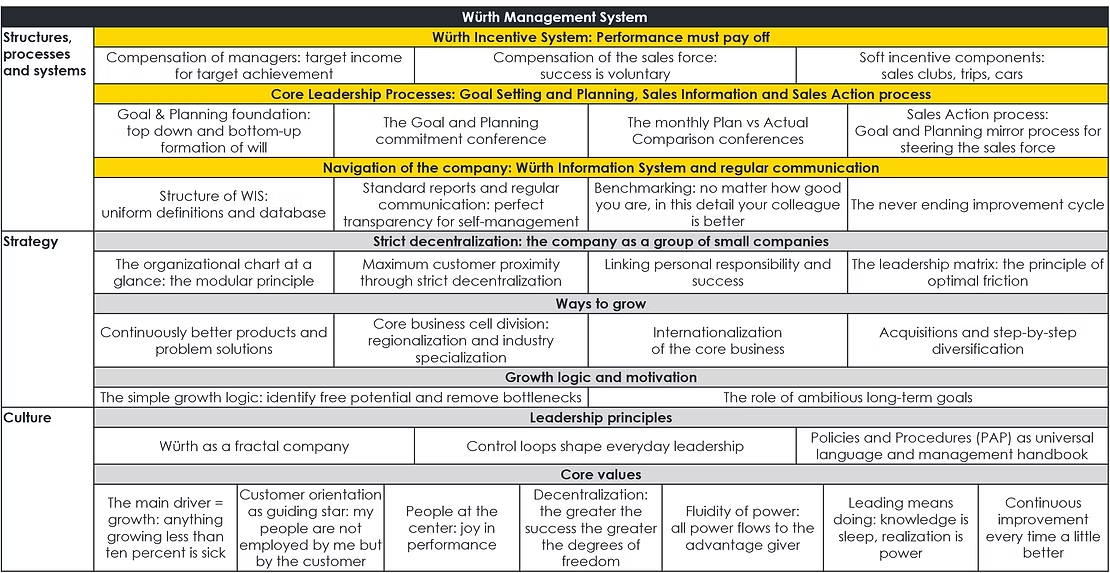
Source: Wachsen wie Würth, by Bern Venohr
The lesson is not to copy the system. It is to build a system patiently over time that works in your own context, guided by values and principles.
How this connects to Built to Adapt
Würth’s system is one of the clearest examples of a company built to adapt:
- It uses tension as a source of innovation and momentum.
- It creates clarity so people can act without waiting.
- It decentralises entrepreneurship while centralising only what is essential.
- It aligns culture, strategy, structure, processes and systems into one coherent operating model.
- It reinforces ownership through performance, autonomy and customer proximity.
- It moves faster than its market through disciplined expansion of territories and relationships.
Würth shows that adaptability depends on structure, clarity, incentives and trust working together to create momentum at every level.
If you want to accelerate growth, increase entrepreneurship or sharpen execution, Würth offers one of the most instructive models of the past half century.