
Weak performance is often treated as a strategy problem, a leadership problem, or an execution problem. In reality, it is often a tension problem. Organisations face decisive dilemmas, speed versus quality, autonomy versus coherence, innovation versus discipline, and either hold them well or they do not. When they do by asking "how can we improve one, through the other", virtuous learning loops form, accelerating performance. When they do not, vicious cycles emerge, control increases, politics spreads, and bureaucracy grows. The role of values is to hold these tensions, not as slogans, but as reconciled opposites anchored in everyday behaviours. That is the missing link between strategy on paper and performance in practice.
Strategy on paper vs strategy executed
The real strategy of a company is not the strategy deck, it is the pattern of decisions people make every day, especially under pressure. Which means that closing the gap between “strategy on paper” and “strategy executed” is not primarily a communication problem, it is a behavioural problem.
The decisive dilemmas hidden inside your strategy
Every serious strategy creates tensions that cannot be solved by picking a side. If your strategy requires speed close to customers, you also need coherence. If your strategy requires innovation at scale, you also need discipline. If your strategy requires premium positioning, you also need cost consciousness. These are not optional trade-offs. They are decisive dilemmas your execution depends on.
Values are tensions, not statements
In real life, the values that matter most come in pairs that pull against each other: decisiveness and thorough analysis, empowerment and clear direction, entrepreneurship and process reliability, purpose and cost efficiency, warmth and professionalism. You also see the same tension expressed as central versus decentral and coherence versus autonomy. Without decentral there is no central. So the purpose of central is for decentral to exist. It's nature. Think of the human body: the body has centralized certain functions such as the heart, the brain, for the rest of the body to function, autonomously.
The trap: choosing a side
The trap is that leadership teams try to “choose a side” and simplify reality, or that ghosts from the past, incentives or governance create one-sidedness. For a short moment that can even look like progress. But the opposite never disappears. It returns later, often as consequences. And those consequences show up as rework, risk incidents, internal friction, customer pain, disengagement, or the slow creep of bureaucracy.
One-sidedness and pathology
When one side breaks loose, you get pathology, a predictable negative loop where the upside turns into its exaggerated form. Decisiveness becomes recklessness. Analysis becomes paralysis. Empowerment becomes chaos. Process becomes suffocation. Autonomy becomes fragmentation. Coherence becomes rigidity. The organisation then compensates with more controls, more escalation, and more politics, which makes the original problem worse.
This one-sided drift is one of the biggest risks in large organisations because it rarely looks dangerous at the start. It looks like focus, clarity, or “finally making a choice”. But it is usually a false trade-off that creates long-term fragility.
You see the same pattern in what Clayton Christensen described as the innovator’s dilemma. Incumbents often understand intellectually that they must keep their current business profitable while also building the next one, yet in practice one side dominates. Either the core is protected so hard that disruption is starved of resources and legitimacy, or the shiny new thing is celebrated in ways that quietly undermine the operational excellence that funds it.
The point is not that leaders are ignorant. The point is that without a discipline for holding opposites together, organisations naturally slide into the comfort of one-sidedness. And that slide is exactly what turns into organisational self-sabotage.
Virtuous learning loops
Dilemma thinking starts from a blunt premise: you do not solve these tensions once, you keep solving them, thousands of times, in small decisions across the organisation. The cumulative pattern of how you solve them becomes your culture. When you hold the tension well, you create virtuous learning loops.
People experience that speed can coexist with quality, autonomy can coexist with coherence, decentral decision-making can coexist with central clarity, and ambition can coexist with discipline. Trust increases, decision quality improves, and execution accelerates in a self-reinforcing way.
Example: the infamous HQ vs. local unit tension
Look at the two circles, left and right. The left is "vicious" because the ropes at the centre have "snapped" and the system is in runaway, its mutual restraints gone. The more top management promotes formality and centralized authority, the more the business units deviate informally and decentralize to escape an influence they dislike. But this only has the effect of increasing attempts to formalize and centralize, which are then resisted in their turn.
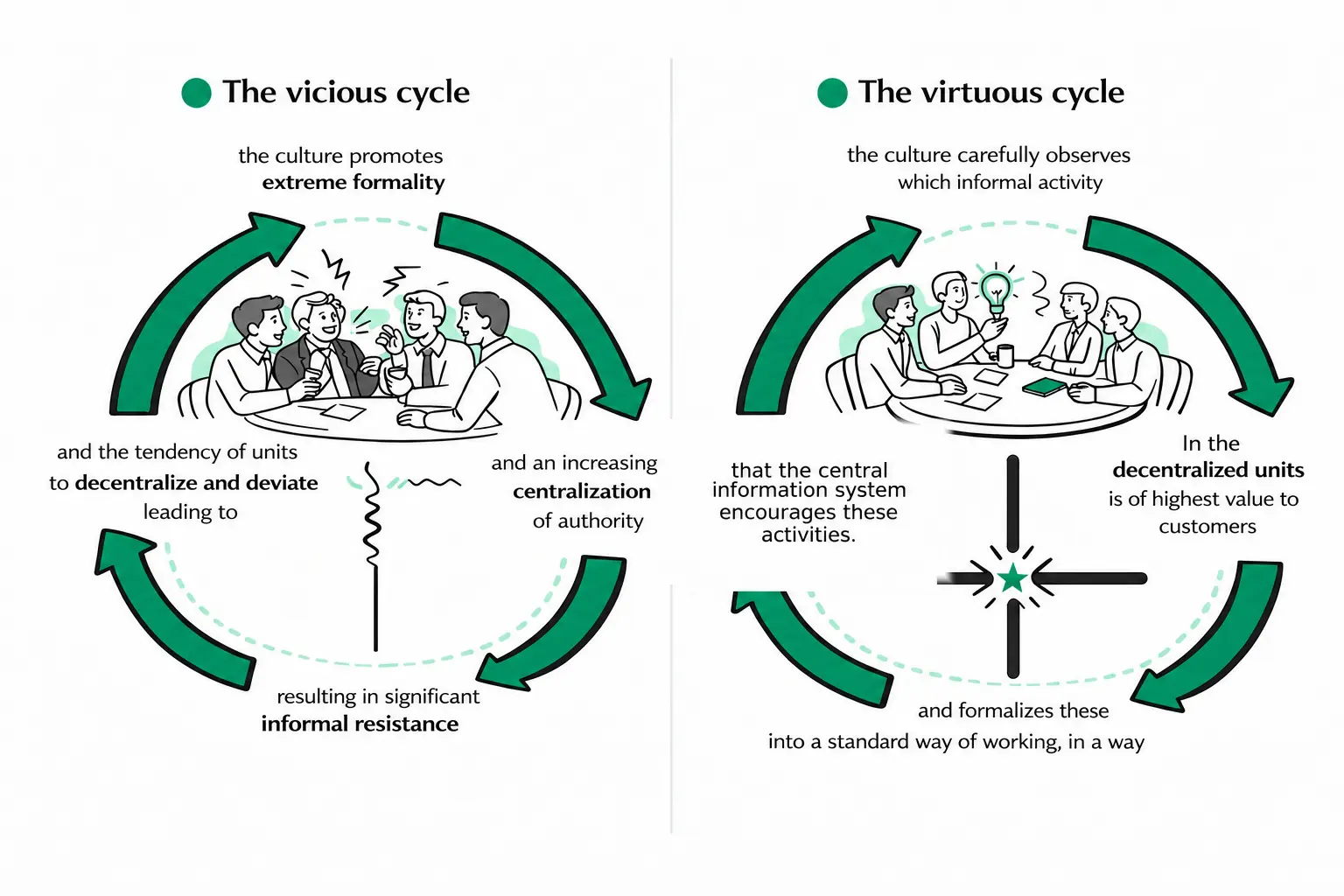
Now look at the opposite on the right, this circle is virtuous because the opposite values of informality-formality, decentralization-centralization remain in creative tension and in mutual restraint. The circle is self-balancing and self-correcting. Those informal activities seen as valuable become integrated into the formal system by official recognition and encouragement. The initiatives of decentralized units are registered at the centre and communicated to other decentralized units for consideration and possible emulation, the centre reserving the right to commend such initiatives or otherwise.
Over time it is likely that the amount of informal activities will increase and the body of formal rules and procedures will grow. The culture will become more decentralized and at the same time better centralized in the sense of guiding and coordinating the autonomous activity of its units.
Dual values still fail without everyday behaviour
The need to keep the tension explains the following Fons Trompenaars quote:
The Value of a Value is the degree to which it helps you reconcile your business dilemma
Values that do not explicitly contain duality are often naïve. A single value statement easily becomes a licence for one-sidedness.
But there is an equally common failure mode, and it is more lethal. Organisations may have values with the right duality on paper and still get nowhere, because they never translate those values into observable everyday behaviours. Until you can point to what a value means on a Tuesday morning in a meeting, in a customer call, in a project trade-off, in a hiring decision, and in a budget discussion, you do not have a value. You have a slogan.
Examples: turning strategy dilemmas into behaviours
- If your strategy requires speed close to customers, leaders need to define behavioural rules that let teams move fast without losing coherence, such as clear decision rights, escalation triggers, and lightweight review routines that prevent rework.
- If your strategy requires innovation at scale, leaders need behaviours that protect experimentation while still enforcing learning discipline, such as short-cycle test-and-learn cadences, explicit kill criteria, and transparent sharing of insights.
- If your strategy requires both premium and efficiency, leaders need behaviours that make cost consciousness strengthen purpose rather than shrink it, such as designing value-engineering choices around customer outcomes instead of across-the-board cuts.
The breakthrough question that shifts the conversation
The practical move is not to turn dilemmas into debates, or to spend your time arguing with the loudest voices who polarise everything into either-or. It is to create a dialogue discipline across the organisation that mobilises the silent middle, the people who can see both upsides and both downsides and are willing to do the harder work of integration.
The central question is deliberately uncomfortable, because it forces a shift in thinking: how can we get more of value X through value Y, and more of value Y through value X? Not so that we compromise our way into mediocrity, but so that we build a better solution than either side could produce on its own.
The bottom line
Dilemma thinking is not a philosophical add-on. It is a performance mechanism. It clarifies the decisive tensions your strategy depends on, it prevents the pathologies of one-sidedness, and it turns values into concrete behaviours that people can practise, learn, and reinforce, until the organisation’s daily operating rhythm expresses the strategy you claim to have.
Invitation
If any of this resonates, let’s talk. I’m happy to do a short, no-prep conversation to identify the 3 to 5 decisive dilemmas in your strategy, where one-sidedness is quietly creeping in, and what everyday behaviours would close the gap between the strategy you describe and the strategy your organisation actually executes. If that’s useful, send me a message.