
In 2009, I started leading a global transformation programme at IKEA. It followed an intensive four-month design phase and would ultimately run for around three years.
As we prepared for implementation, I proposed something fairly conventional: a programme management office that would track activities, monitor milestones and report progress. The proposal was rejected, and not gently. I almost felt as if I had been kicked out of the room, and I was genuinely confused, because this was the standard setup at every other client I had worked with.
The argument went back to one of IKEA's deeply held values: "Giving and taking responsibility is a privilege." If teams were genuinely responsible for delivering the transformation, why would we build a central office whose primary role was to check whether they were doing what they had committed to do?
It was a fair challenge, so we changed the question.
Instead of asking:
Are the teams following the plan?
we started asking:
Do the teams have the conditions they need to execute?
This fundamentally changed the way we ran the programme.
Four conditions for execution
We used a simple model built around four conditions:
- A common purpose
- Pressure for change
- Capacity to change
- A realistic work plan
The model also had enough humour to make it memorable. Remove one of the conditions and predictable failure patterns emerge: anarchy, a slow death, a nervous breakdown, or plenty of hype with very few results.
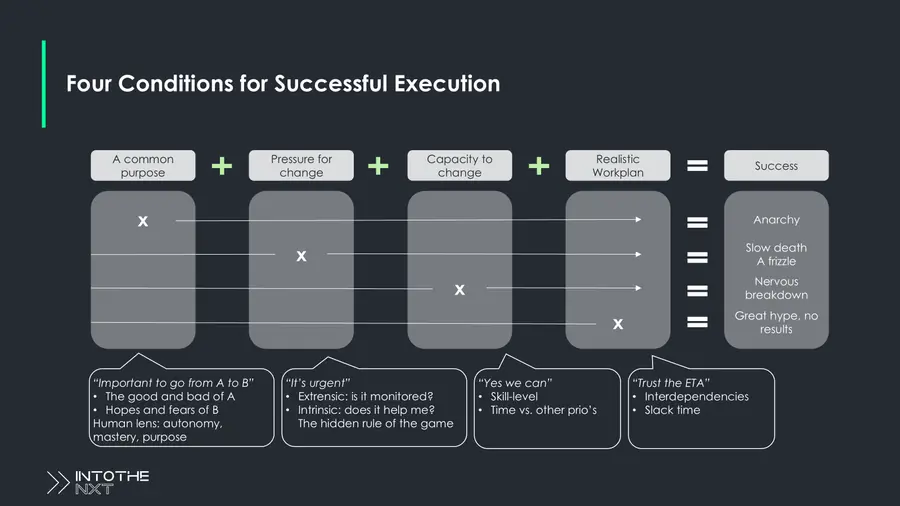
The important point was that our small central team was allowed to monitor these conditions rigorously.
When one of them was missing, we brought it to the surface. Sometimes that resulted in serious discussions at Board level. Sometimes resources had to move. Sometimes it meant working with the teams to go through the analysis to re-establish the rationale for change.
But the intervention was aimed at removing obstacles to execution, rather than taking responsibility for execution away from the teams.
Teams rewrote their own project charters. They made their own commitments. And because those commitments were theirs, accountability remained where it belonged. Later I read in Cialdini's "influence" that this writing down over over and over is a powerful way to get commitment.
The basic model is useful, but now, having learned so much more about what what moves people, I would go further, particularly on the first two conditions. Because while "common purpose" and "sense of urgency" can sound deceptively simple, they are deeply human.
1. Common purpose: "It is important to get from A to B"
A common purpose exists when the people responsible for execution can genuinely say:
"I find it personally important that we move from A to B."
That is stronger than understanding the strategy. People can understand a strategy perfectly well and still have little desire to act on it. When somebody hesitates to move from A, the old situation to B, the new, there are usually forces pulling in both directions.
They may dislike elements of the current situation, but still value things they would lose by leaving it. They may see clear advantages in the new situation while simultaneously worrying about what it means for their role, status, competence or autonomy.
This is what I learned from the late Harvard Professor Clayton Christensen: the four forces of adoption: push, habit, pull and anxiety.
- Push: what makes the current situation unattractive?
- Habit: what still makes the current situation attractive?
- Pull: what do people hope the new situation will bring?
- Anxiety: what do they fear about the new situation?
A strategy gains traction when push and pull together outweigh habit and anxiety, when the forces moving people towards B become stronger than those holding them at A.
Underneath those forces sits intrinsic motivation. Daniel Pink's three elements, autonomy, mastery and purpose, act as accelerators or brakes on the forces themselves. They shape how strong the push, pull and anxiety actually become.
Autonomy: will I keep meaningful control over my work? If the change threatens that control, it feeds anxiety. If it protects or widens it, it adds to the pull.
Mastery: can I become good at what the new situation requires? Doubt here shows up as anxiety about the change. A credible path to competence turns that same force into pull.
Purpose: does this feel worthwhile? When it does, it sharpens the push away from a hollow status quo and strengthens the pull towards B. When it is missing, nothing pulls.
This is why explaining the corporate rationale for a transformation is rarely enough. People interpret that rationale through their own work, ambitions, capabilities and concerns.
A common purpose eventually has to become personal "I want this". The next part is about wanting it now.
2. Pressure for change: "It's urgent"
What you ultimately want to hear is:
"This matters, I want to get this now."
Importance plus urgency creates priority as well know from the prioritisation 2 x 2 grid.
The classic way to create urgency is extrinsic: make progress visible, monitor commitments and hold people accountable for delivery. Classic (bi) weekly progress reviews.
It works to ensure something happens quickly. But it can also backfire.
The more closely people feel monitored and controlled, the more responsibility starts to shift away from them. They begin to execute because someone is checking, rather than because they have taken ownership. At IKEA, that was exactly what the ExCom wanted to avoid.
The more important source of urgency is intrinsic, and it is often overlooked:
Does succeeding in this transformation help me achieve something that already matters to me?
Every organisation has hidden rules of the game. People continuously work out:
- What do I want to achieve? (think of fast promotion, job security, status among by peers)?
- Who here can give that to me?
- Based on what criteria?
If the transformation helps people succeed within that reality, they will naturally want it to move faster. But if it competes with this, the transformation may formally be called a top priority while people's behaviour tells you otherwise. That is why urgency cannot simply be imposed. It needs to connect to what genuinely matters to the people responsible for execution.
3. Capacity to change: "Yes, we can"
The third condition is more practical:
"I am capable of doing this, and I have the capacity to do it."
Capability is about skill level. A team may believe wholeheartedly in the transformation and still not have the specific skills the new situation demands. That gap is fixable, but only if it is named honestly rather than assumed away.
Capacity is relative to everything else on the team's plate. A team may have exactly the right skills and still have no room, because existing priorities already consume the working week. Leadership teams routinely underestimate this. Adding a strategic priority without taking something off the list is accumulation dressed up as prioritisation, and the new work loses every time it collides with the day job.
So an honest discussion has to cover the skills the change requires and competing priorities that will otherwise win by default.
4. A realistic work plan: "Trust my ETA"
Finally:
"You can trust me to deliver when I say I will."
In a complex transformation, few teams operate independently. My estimated time of arrival becomes somebody else's starting point, so a missed date is rarely contained. It ripples into every team waiting on the output.
Two factors decide whether a plan survives contact with reality.
The first is interdependencies. Teams need to know which other projects they rely on and which rely on them, including the ones outside the transformation that compete for the same people and the same systems. A plan that maps only its own tasks and ignores what it is plugged into looks tidy and breaks early.
The second is slack. In a programme this size, delays are the base rate rather than the exception. A plan with every task packed end to end assumes nothing will ever slip, which guarantees that the first slip cascades. Building in deliberate slack absorbs the delays that will happen anyway and keeps one team's problem from becoming everyone's.
The objective is dependable coordination rather than perfect forecasting.
From programme control to conditions for performance
The lesson I took from IKEA was never that programme management offices are unnecessary. Some transformations genuinely need rigorous controls, reporting and formal governance. The problem is that conventional programme management easily focuses on the wrong object. A dashboard can tell you a milestone is red, but it rarely tells you why the people responsible cannot or will not deliver it, and that is where leadership has to look underneath the plan: whether people want to get from A to B, whether they want to get there quickly, whether they can, and whether everyone else can rely on their commitments. Those four questions create a very different conversation about execution, and quite often the fastest way to improve delivery is to find and remove whatever is stopping people from taking responsibility in the first place.
Under all this sits a very fundamental assumption about human behavior. Do you believe people are genuinely motivated to do what's right, and thus it's all about removing obstacles? Or, do you believe the other side, that people need to be controlled? This fundamental worldview lies under the program design and is worth discussing when you start the programme, as I very quickly found out at IKEA back in 2009.