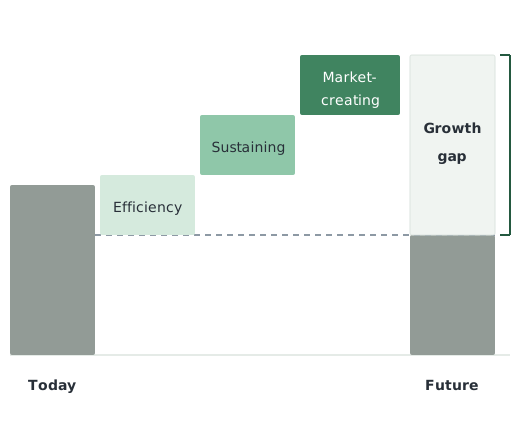
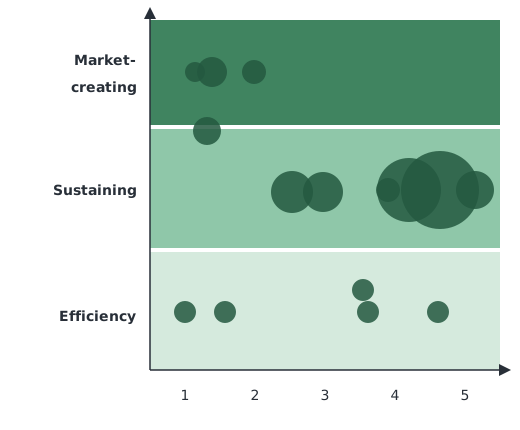
Growth Blueprint The plan for innovation-driven growth, including objectives and targets, the opportunities and tactics we will pursue or rule out, and where to look for attractive future growth.
Growth Goals The quantitative and qualitative goals for each type of growth and for the overall innovation portfolio.
What good looks like Growth goals are agreed through long-term strategic planning and translated into unit commitments. The target portfolio specifies the desired mix and contribution of each growth type. Long-term innovation domains set priorities, assessed under Growth Guidelines and Boundaries.
1. Do leaders agree on our near- and long-term growth goals? Requires attention Near- and long-term goals are unclear or inconsistent, with little connection to the strategy.On the way Leaders agree on a broad ambition, but specific goals or their connection to long-term strategic planning remain unclear.Established practice Leaders agree on near- and long-term goals developed through strategic planning and can explain how they support the strategy.
2. Have we defined what success looks like for each type of growth? Requires attention We have few explicit measures or rely on a single overall target.On the way Some growth types have clear targets, but qualitative outcomes or appropriate financial measures are missing for others.Established practice Each growth type has suitable quantitative targets and qualitative outcomes, such as financial contribution, brand impact or access to new capabilities, appropriate to its stage.
3. Do we know how much growth we expect from the core and from other growth types? Requires attention We have an overall ambition but little clarity on where growth will come from.On the way We have a rough split between core and beyond-core growth.Established practice Leaders agree the expected contribution and desired portfolio mix across growth types and priority innovation domains, showing how they add up to the overall ambition.
4. Do business units use the goals to guide their plans and decisions? Requires attention Growth goals rarely shape unit plans, everyday decisions or leadership performance discussions.On the way Some units translate goals into plans, but their use in everyday decisions and leadership performance discussions varies.Established practice Relevant units translate the goals into commitments and use them to set priorities, review progress and assess leadership contributions.
5. Do we check whether our current portfolio can deliver those goals? Requires attention We review initiatives individually, with little sense of what they can deliver together.On the way We sometimes compare the portfolio with the goals, but gaps seldom lead to decisions.Established practice Leaders regularly compare the portfolio’s expected contribution with the growth goals and current conditions, then decide where to add, reshape or stop work.
Growth Guidelines and Boundaries Guidelines and boundaries define what is desired, what is off the table and what is open for discussion. They steer innovation in the right direction and help teams avoid unfruitful paths. These constraints create a clear sandbox that encourages creativity and experimentation.
What good looks like Leaders and teams agree on long-term innovation priorities, clear limits and which opportunities need discussion. These are documented and used in opportunity development, funding and review decisions. Teams have freedom to explore within the agreed sandbox. The guidelines are revisited as the company and its industry change.
1. Have we agreed where to look for future growth? Requires attention Opportunities depend largely on what individuals bring forward, with little shared long-term direction.On the way Some parts of the business have innovation themes, but leaders are not aligned on the long-term priorities or how they were selected.Established practice Leaders have systematically agreed and documented long-term innovation priorities, such as customer problems, markets or technologies to explore over the next three years and beyond.
2. Have we defined what makes an opportunity attractive and what is outside scope? Requires attention Leaders have no shared criteria for attractive opportunities or tactics, or for what is outside scope.On the way Some guidelines exist, but leaders interpret priorities and boundaries differently.Established practice Senior leaders agree on documented prioritisation criteria, attractive opportunities and tactics, and clear boundaries.
3. Are the guidelines built into innovation decisions and processes? Requires attention Guidelines rarely affect which opportunities teams develop, fund or review.On the way Some teams follow the guidelines, but development processes, funding decisions or reviews apply them inconsistently.Established practice Leaders and teams use the guidelines consistently. Opportunity development, funding and review processes explicitly reflect them.
4. Do we revisit the guidelines as conditions change? Requires attention We revisit them mainly in response to a problem.On the way We review them occasionally, but the review seldom changes what teams do.Established practice We review them regularly and when important assumptions change, then communicate any changes to teams.
Innovation Processes The processes, milestones and decision points that take each type of growth from spotting opportunities through designing solutions, testing and learning, and scaling.
What good looks like Processes cover all four stages and are routinely used. They vary by growth type, allow iteration and justified exceptions, and anticipate later-stage needs. Customer evidence, business model choices and experiments guide decisions about whether and how to scale.
Process design 1. Do teams use an innovation process suited to the type of growth? Requires attention The process is unclear, ignored or the same for every growth type. Teams deal with stages separately.On the way A process is used in some areas, with occasional tailoring. Iteration, exceptions or preparation for later stages depend on individual initiative.Established practice Teams routinely use clear processes across all four stages, tailored to growth type. They can iterate, handle justified exceptions and consider later-stage needs early.
2. Do we know what evidence we need at each stage? Requires attention It is unclear what teams should produce or prove, or when an idea should advance, return for more work or stop.On the way Some stages have evidence requirements and decision points, but their use varies.Established practice Each stage has clear activities, deliverables, evidence requirements and decision points. Teams use them to proceed, revisit earlier work or stop.
Spot opportunities 3. Do we understand the problems customers and potential customers are trying to solve? Requires attention Opportunities mainly start from our products or technologies, with little direct investigation of customer needs.On the way Teams sometimes investigate customer needs, but usually focus on existing customers and familiar problems.Established practice Teams observe and speak with customers and people our offering does not serve. They use evidence of unmet needs to identify opportunities in our priority areas.
Design solutions 4. Do we design around the whole customer experience and the trade-offs customers will make? Requires attention Solutions reflect our internal quality standards, with little attention to how people buy, use or obtain support for them.On the way Customer experience is considered early, but some parts of the journey or acceptable performance trade-offs receive little attention.Established practice Teams use customer evidence throughout design, consider the whole journey, and make explicit choices about performance, convenience and price.
5. Do we explore different solutions and business models before committing? Requires attention Teams move quickly to a preferred solution and assume our current business model will fit.On the way Teams explore alternatives, but usually retain the core business model without fully testing its fit.Established practice Teams explore several solutions and ways to create and capture value, document the choices, and retain elements of the core model where they help.
Test and learn 6. Do we identify and prioritise the assumptions that could make an opportunity fail? Requires attention Teams treat early judgements as facts or leave important assumptions unstated.On the way Teams list some assumptions, often focused on the product or technology, but priorities are unclear.Established practice Teams record customer, commercial, technical and operational assumptions, assess confidence in the evidence, and prioritise those with the greatest consequences if wrong.
7. Do test results change the solution and guide learning across teams? Requires attention Results rarely change the solution, and learning stays with the team.On the way Teams sometimes change the solution, but do not consistently revisit other assumptions or share usable evidence.Established practice Teams adapt the solution, revisit affected assumptions and choose the next test. Findings are recorded in a shared, accessible source that other teams use to avoid repeating work.
Scale 8. Do we have evidence that an opportunity is ready to scale, and expand at an appropriate pace? Requires attention Launch timing or ambition drives expansion, with little agreement on the evidence needed.On the way Some readiness criteria exist, but the size or pace of launch does not consistently reflect uncertainty.Established practice Leaders agree the evidence and performance measures needed to expand. The scale and pace of launch reflect the maturity of the solution and business model.
9. Before expanding, have we secured an organisational home, a suitable team and the capacity to deliver? Requires attention Ownership, team responsibilities and operating needs remain unclear when expansion begins.On the way An organisational home is identified, but staffing, support or shared capacity are arranged late.Established practice The opportunity has a clear organisational home, sponsorship, infrastructure and a suitable team involved early. Leaders confirm capacity and manage the effect on the core before expansion.
Production Structures The structures and resources supporting specific stages of innovation, including idea sourcing, incubation, experimentation and external partnerships.
What good looks like Teams can access support appropriate to the opportunity and stage. Idea sourcing reaches beyond existing markets, incubation has a clear mandate and links to the core, experiments receive resources quickly, and partnerships or acquisitions fill capability gaps.
1. How systematically do we find and capture promising ideas? Requires attention Ideas come mainly from familiar people or conventional research, with no reliable way to retain them.On the way We gather ideas from parts of the company and some external sources, but outreach, storage and reassessment are inconsistent.Established practice We actively seek ideas across the company, outside it and beyond current markets, using several discovery methods. Ideas are captured and periodically reconsidered.
2. Can we give uncertain ideas room to develop? Requires attention Uncertain ideas compete with established work, with no dedicated mandate, resources or clear links to the core.On the way Some ideas receive incubation support, but responsibilities overlap with core work or links to the core are unclear.Established practice Incubation has a clear mandate and dedicated resources for growth beyond the core, with deliberate links to core capabilities and a route into an appropriate home.
3. Can teams run experiments that inform decisions? Requires attention Teams tend to build first, and lack a suitable environment or resources for early experiments.On the way Pilots or informal testing spaces exist, but access to people, funding or customers is slow or tests have unclear learning goals.Established practice Teams quickly access a safe testing environment and resources for small, focused experiments. They agree predictions, measures, time and spending limits before testing important assumptions.
4. Can we work with external partners when they bring something we need? Requires attention External help depends on personal contacts, with little connection to the innovation process.On the way Partnerships or acquisitions support some ideas, but teams lack a clear route to assess and access external capabilities.Established practice Teams can access partnership and acquisition expertise through the innovation process, assess strategic fit, and obtain capabilities needed for the opportunity.
Governance and Controls The mechanisms for managing individual innovation initiatives, the overall growth portfolio and resource allocation, and for improving the innovation system over time.
Idea Management The governance mechanisms for reviewing individual initiatives, judging progress and making decisions on the next stage.
What good looks like Criteria and deliverables reflect each growth type and stage, moving from early qualitative evidence to quantitative measures as uncertainty falls. Reviewers bring relevant expertise and perspectives. Dedicated resources and clear funding routes support different growth types, assessed under Resource Allocation.
1. Do we judge ideas by criteria appropriate to their growth type and stage? Requires attention We typically ask every idea for the same business case or lack clear review criteria.On the way Some reviews allow for uncertainty, but required evidence and deliverables vary by reviewer.Established practice Reviewers use clear criteria and deliverables suited to growth type and stage, moving from early qualitative evidence to quantitative analysis as the idea develops.
2. Can teams get a timely decision on what happens next? Requires attention It is often unclear who decides or when a decision will be made.On the way Reviewers are known, but decisions or follow-through vary.Established practice Teams know who can decide and get a clear decision to continue, change course or stop.
3. Do innovation reviewers bring the experience and perspectives needed to judge opportunities? Requires attention Review responsibility is unclear or decision-makers lack experience relevant to the opportunity.On the way A review group exists, but important skills or perspectives are missing.Established practice A clear review group brings relevant skills and experience, including internal and external perspectives where useful, to judge growth beyond the core.
Portfolio Management The systems for tracking and reviewing the innovation portfolio and updating priorities as performance and strategy change.
What good looks like Leaders have a current portfolio view, manage towards financial and strategic goals and the desired growth mix, and link reviews with strategy. Regular external scanning informs decisions. There is a clear route to stop, exit or divest work that no longer fits.
1. Do we have a shared view of the innovation portfolio? Requires attention Initiatives are tracked separately, with little leadership visibility of the overall portfolio.On the way A portfolio view exists, but it is incomplete, out of date or difficult for leaders to access.Established practice Leaders can readily access a current view by growth type and stage, including progress, risk, strategic fit and expected financial contribution.
2. Do portfolio reviews lead to changes in priorities? Requires attention Reviews mainly report individual progress. Work with weak prospects or poor fit tends to continue.On the way Leaders discuss the mix, but links to strategy and decisions to start, reshape or exit work are inconsistent.Established practice Regular reviews connect to strategy, financial goals and the desired growth mix. A clear process identifies work or businesses to reshape, stop, exit or divest, with agreed objectives and next steps where relevant.
3. Do we examine emerging trends, disruptive threats and opportunities and use them to update our strategy and portfolio? Requires attention We rarely seek external signals or bring them into strategy and portfolio decisions.On the way We gather external information occasionally, but its use in decisions depends on individuals.Established practice We systematically scan for emerging trends, threats and opportunities, challenge portfolio assumptions, and feed the findings into strategy and investment decisions.
Resource Allocation The systems for tracking, reviewing and rebalancing people, funding and shared capacity across innovation opportunities.
What good looks like Different growth types have dedicated resources and clear routes to access them. Portfolio priorities guide allocation, and leaders monitor the use of shared capabilities so bottlenecks can be addressed as needs change.
1. Can teams access people and funding to test promising ideas? Requires attention Teams must find spare capacity or compete with core work for every funding request.On the way Some innovation resources exist, but protection from competing demands or the funding route for each growth type is unclear.Established practice Different growth types have dedicated, protected people, funding and essential systems. Teams understand how to access the resources needed for their next stage.
2. Can we move resources when evidence or priorities change? Requires attention Allocations stay in place until the next planning round, regardless of portfolio priorities or new evidence.On the way Exceptions are possible, but moving people or funding to priority work is difficult.Established practice Leaders regularly rebalance people, funding and shared capacity using portfolio priorities and evidence, including releasing resources from work that stops.
3. Do we know which shared capabilities constrain innovation, and how much capacity is available? Requires attention We do not track overall innovation capacity, and shared constraints emerge late.On the way Teams can identify some constraints, but capacity and utilisation are assessed inconsistently.Established practice Leaders monitor overall capacity and use of critical shared capabilities, such as IT or specialist expertise, and act on constraints affecting priority initiatives.
Continuous Improvement The systems for assessing and improving the organisation’s ability to deliver innovation-driven growth over time.
What good looks like Someone regularly assesses the ability to provide resources and support across initiatives. The organisation invests proactively in removing bottlenecks and follows a funded capability-development plan with actions and milestones.
1. Do we identify recurring bottlenecks across initiatives? Requires attention Resource and support problems are dealt with initiative by initiative, with little assessment of the wider system.On the way Recurring delays are discussed, but the ability to provide resources and support is not assessed consistently.Established practice Someone regularly assesses whether initiatives receive the resources and support they need, identifies recurring constraints and traces them to how the system works.
2. Do we test changes and share what works? Requires attention Bottlenecks persist and changes are rarely tested or reviewed.On the way Teams try local improvements, but investment, follow-through or sharing of lessons is inconsistent.Established practice The organisation proactively invests in removing or working around constraints. Teams test changes, review their effects and share practices that work.
3. Do we have a funded plan, with milestones, for improving our innovation capabilities? Requires attention Capability development happens through isolated fixes, with no shared plan.On the way A broad plan exists, but actions, milestones or resources are unclear.Established practice An agreed plan sets capability objectives, actions, milestones and resources across discovery, design, experimentation and scaling, building on existing strengths where possible.
Leadership, Talent and Culture The roles, skills, behaviours and ways of working that support innovation, together with the development, performance and reward practices that sustain them.
Leadership Behaviours The actions leaders take to advance innovation and shape how people approach uncertain work.
What good looks like Leaders give innovation sustained attention, connect it to purpose, support intelligent risk-taking and recognise success and learning. They observe customers, help resolve uncertainty, remove barriers and challenge assumptions while maintaining appropriate oversight.
1. Do leaders spend meaningful time on growth and innovation? Requires attention Leadership attention is limited to occasional updates, and the purpose of innovation work is unclear.On the way Some leaders engage regularly, but attention fades under pressure or links to the organisation’s purpose remain vague.Established practice Leaders make sustained time for innovation decisions, explain why the work matters to the organisation and follow through on commitments.
2. Do leaders model the behaviours they expect? Requires attention Teams see leaders mainly reward predictable outcomes and avoid setbacks.On the way Leaders encourage experimentation, but reactions to setbacks vary.Established practice Leaders ask what was learned, act on evidence and support well-designed experiments that overturn an assumption.
3. Do leaders directly observe and speak with customers about their needs? Requires attention Leaders mainly rely on reports and internal interpretations of customer needs.On the way Some leaders participate in customer research, but contact is occasional or narrow.Established practice Leaders regularly speak with and observe customers, use those encounters to question assumptions, and bring what they learn into innovation decisions.
4. Do leaders help resolve uncertainty and remove barriers that teams cannot address themselves? Requires attention Teams are largely left to navigate unclear decisions and organisational barriers.On the way Leaders offer support, but action on uncertainty or barriers is limited or inconsistent.Established practice Teams can raise uncertainties and barriers. Leaders help clarify the decisions required, remove obstacles within their authority and follow through.
5. Do leaders challenge established assumptions while setting appropriate limits for experimentation? Requires attention Leaders defend existing approaches or demand certainty before allowing teams to test alternatives.On the way Some leaders encourage challenges, but teams encounter inconsistent reactions or unclear limits.Established practice Leaders question established approaches and invite evidence that challenges their own views. Clear limits allow experimentation while protecting commitments that matter.
Innovation Talent The skills, experience, attitudes and working habits people bring to innovation, and how teams are assembled.
What good looks like Teams have the relevant experience, skills and size for their growth type and stage. People make time for innovation, take considered risks, learn from setbacks, question established approaches and seek different perspectives.
1. Do we staff innovation teams for the work ahead? Requires attention Teams are formed mainly around availability or traditional qualifications, without considering relevant innovation experience.On the way Key skills are identified, but experience gaps or team size are addressed late or vary little by growth type.Established practice Teams have the relevant practical experience, mix of skills and size for their growth type and stage, with roles adjusted as the work develops.
2. Can we bring in experience we lack? Requires attention Teams mostly work with the skills already available to them.On the way Teams can find specialist help, but access depends on informal contacts.Established practice Teams can draw on expertise from elsewhere in the organisation or outside it as needs change.
3. Do people have time allocated to innovation alongside their other responsibilities? Requires attention Innovation relies on spare time and is repeatedly displaced by day-to-day work.On the way Some time is allowed, but competing responsibilities often prevent people using it.Established practice Innovation time is explicitly allocated and protected through workload decisions, with expectations suited to each person’s role.
4. Do people seek different perspectives and challenge established ways of working? Requires attention People stay within familiar networks and hesitate to question assumptions.On the way Some people seek different perspectives or challenge existing practices, but it is sporadic or concentrated in a few teams.Established practice People actively connect across roles and external networks, combine different experiences and test established assumptions. They take considered risks and use setbacks as opportunities to learn.
Measurement and Rewards The measures, performance practices and incentives that recognise people’s contribution to innovation.
What good looks like Innovation skills and behaviours are reflected in hiring, reviews, staffing and career progression. Recognition values intelligent risk-taking, learning and outcomes appropriate to the stage. Development and communication reinforce these expectations.
1. Do hiring and performance conversations recognise innovation skills? Requires attention Hiring, reviews and staffing decisions focus mainly on operating delivery, with little attention to innovation skills.On the way Some managers consider innovation skills, but criteria and their use in hiring, reviews or staffing vary.Established practice Hiring, reviews and staffing policies use clear evidence of relevant innovation skills and behaviours. Development and communication reinforce these expectations.
2. Do rewards recognise useful learning as well as results? Requires attention Taking on uncertain work can damage recognition or career prospects when it does not pay off.On the way Learning is praised, but rewards or career progression still mainly favour predictable delivery.Established practice Rewards, performance reviews and career progression recognise sound decisions, intelligent risk-taking and useful learning, alongside outcomes appropriate to the stage.
Development Programmes Training and practical learning that develop innovation skills, mindsets, behaviours and a shared language.
What good looks like A clearly responsible group develops innovation capability and spreads expertise across the company. Learning combines practice, feedback and common concepts, with programmes tailored to leaders, practitioners and their experience.
1. Do people have a shared language for innovation? Requires attention Teams use key terms differently, making it hard to compare work or learning.On the way A common language exists in parts of the business.Established practice People use shared concepts in planning, experimentation and reviews.
2. Can people build innovation skills through practice? Requires attention Development depends on individual initiative, with little organised training or practical support.On the way Training or coaching exists, but links to real work or differing development needs are limited.Established practice Leaders and practitioners build skills through real opportunities, coaching and feedback, with learning tailored to their roles and experience.
3. Is someone responsible for developing innovation capability and spreading expertise across the organisation? Requires attention There is no clear responsibility for developing or sharing innovation capability.On the way Individuals or teams provide support, but their mandate, reach or follow-through is limited.Established practice A clearly responsible group builds skills and shared practices, transfers expertise across the company and supports changes in how people work.
Culture Awareness How the organisation understands and develops the everyday culture supporting innovation-driven growth.
What good looks like The organisation regularly assesses the conditions for innovation and acts on what it learns. Priorities, efforts and results are communicated widely, and useful contributions and successes are recognised. Leadership and reward practices reinforce the culture.
1. Do we examine what helps or hinders innovation in everyday work? Requires attention We rely mainly on anecdotes or general impressions.On the way We gather feedback occasionally, but it rarely leads to a clear diagnosis.Established practice We use concrete examples to identify where everyday norms help or hinder innovation.
2. Do we act on what we learn about the culture? Requires attention Culture concerns are discussed without changes to how people work.On the way Some changes are tried, but their effect is rarely reviewed.Established practice Teams agree specific changes to working practices and check whether behaviour improves.
3. Do we regularly share innovation priorities, progress, results and learning across the organisation? Requires attention Innovation priorities and results are rarely shared, and contributions receive little recognition.On the way Stories and results are shared occasionally or with a narrow audience, with inconsistent recognition.Established practice We regularly communicate priorities, efforts, results and learning across the company and recognise useful contributions and successes.